Study figure and data
Tretinoin: a tissue measurement
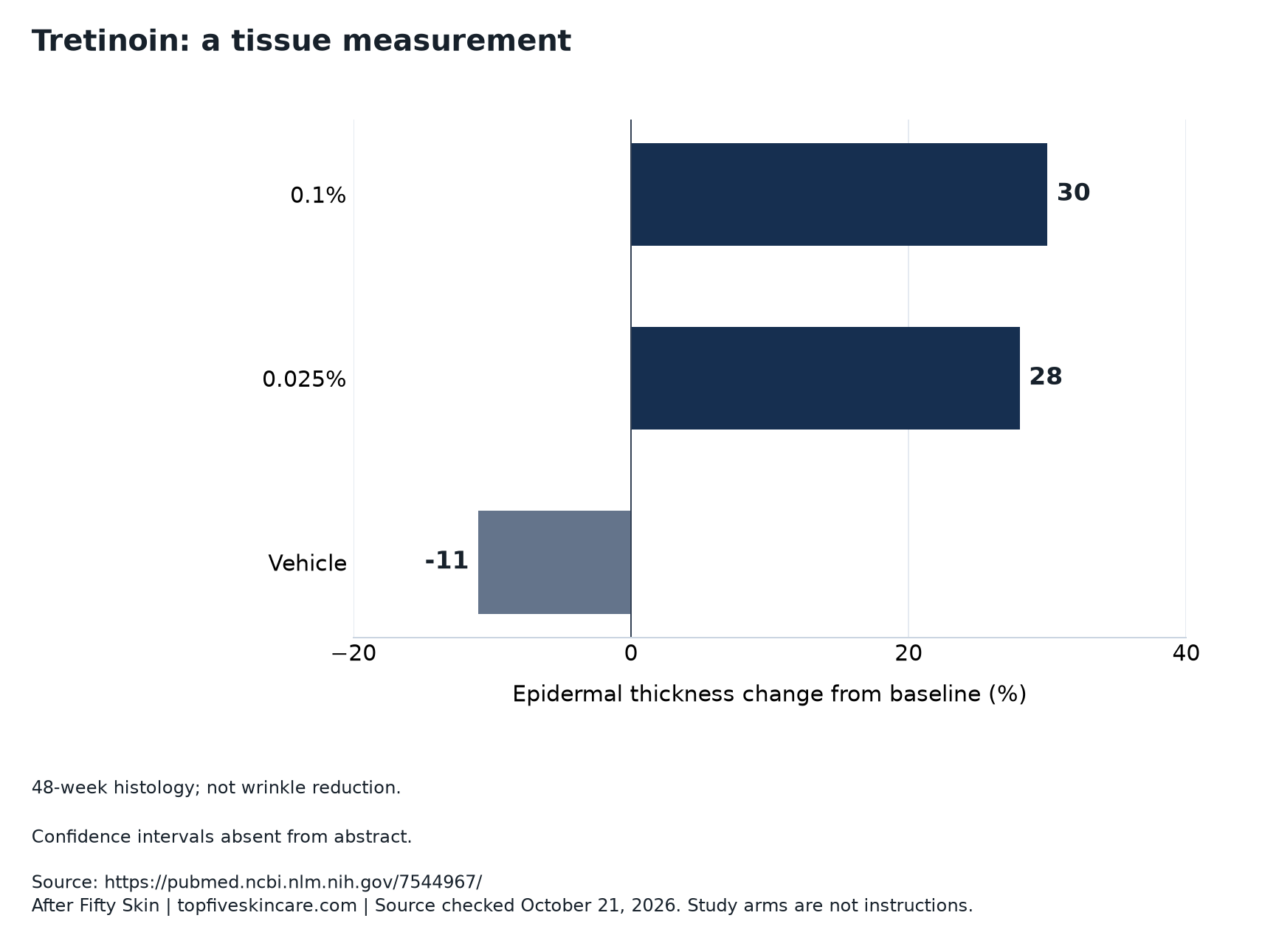
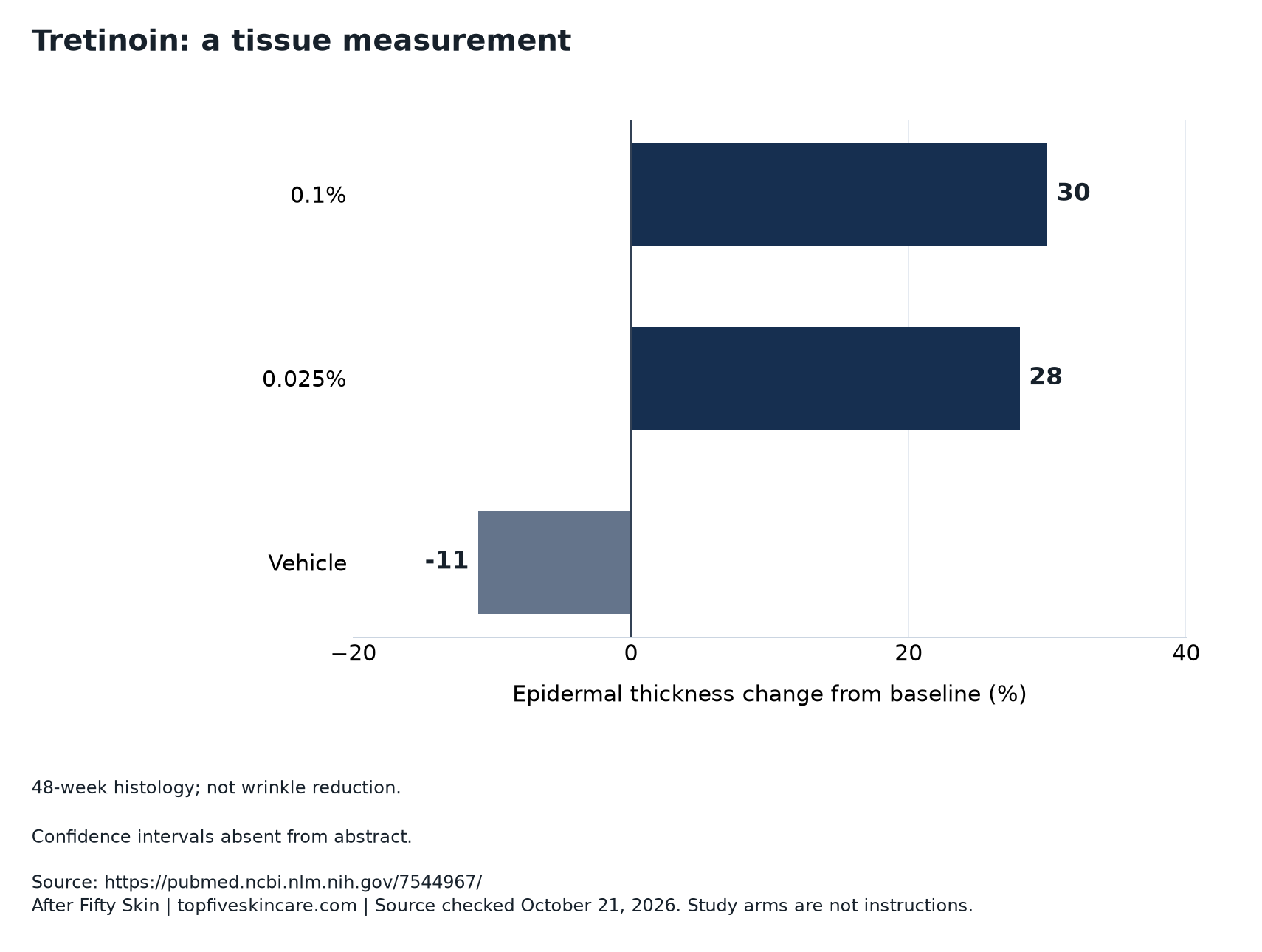
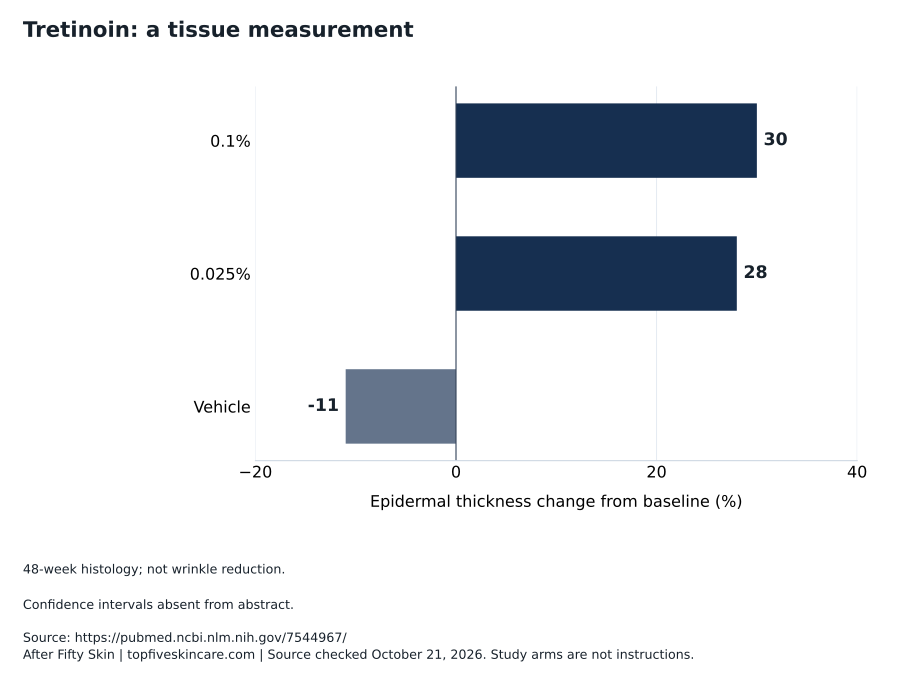
48-week histology; not wrinkle reduction.
Confidence intervals absent from abstract.
Download chart (PNG)Download data (CSV)Download vector chart (SVG)
| Study arm | Reported value |
|---|---|
| 0.1% | 30 |
| 0.025% | 28 |
| Vehicle | -11 |
Start with the actual comparison
The indexed 1995 abstract describes a 48-week, double-blind cream comparison with 99 completers: 32 using 0.1% tretinoin, 35 using 0.025%, and 32 vehicle. Facial improvement was similar between active concentrations; erythema and scaling were greater with 0.1%. Initial enrollment, allocation method, confidence intervals and funding cannot be established from this accessible abstract. The plotted tissue percentages concern epidermal thickness, not wrinkle reduction.
Reading a comparison begins by giving each quantity a job. The formulation is the assigned condition. The clinical assessment is an outcome. The length of observation specifies when that outcome is assessed. The count describes which people appear in the reported summary. Treating these as separate entries prevents a common shortcut: using a precise concentration to imply an equally precise estimate of benefit. Precision in a product description cannot replace precision in an outcome estimate.
The practical reading habit is to write the question as a sentence before judging the answer. Which outcome differs between which conditions, in which people, at which time? Our guide to retinoid decisions provides the broader care context; here, the narrower task is to keep every conclusion attached to its actual comparison.
A vehicle is a comparison condition
A vehicle is the preparation used to carry an active ingredient. In a controlled study, it also gives the investigator a reference condition. Comparing an active preparation with that reference asks what differs between the two conditions as studied. It does not automatically estimate a contrast with doing nothing, and it does not turn the vehicle into a universal stand-in for every moisturizer. The relevant question is how the preparations and accompanying procedures were matched.
This distinction matters even when a comparison group improves. A change in that group could reflect several influences: the reference preparation, shared care, the passage of time or measurement variation. Without comparisons that separate those influences, assigning the entire change to one explanation is unjustified. Likewise, calling a vehicle inert can obscure the actual design question. The useful description is what the control contained and what participants experienced, rather than a reassuring label.
The table distinguishes possible questions without supplying undocumented ingredients for this trial. As an editorial reading aid, our moisture-support comparison can help separate a product’s proposed role from the experimental comparison needed to test that role. Similar everyday descriptions do not make two research controls interchangeable.
| Comparison | Question addressed | Information still needed |
|---|---|---|
| Active preparation versus matched vehicle | What differs when the active preparation replaces its reference? | Matching of formulation and accompanying procedures |
| Active preparation versus no preparation | What differs between the complete intervention and no preparation? | Other care, attention and assessment differences |
| One active concentration versus another | How do the studied active conditions compare? | Outcome precision and formulation comparability |
| One group before versus after | What changed over the observation period? | A defensible account of what would otherwise have happened |
The missing alternative for the same person
The ideal causal question imagines two outcomes for the same person at the same time: one under each condition. Only one of those outcomes can be observed for a given skin site in an ordinary parallel comparison. The other is the counterfactual, meaning the outcome under the alternative that did not happen. A comparison group helps estimate that alternative, but its usefulness depends on whether the groups would otherwise have followed comparable paths.
This is why assignment matters. If a study deliberately or accidentally gives one condition to people who are different at the outset, the later contrast may mix the condition’s effect with those starting differences. Random assignment is one design approach to this problem, but the word should only be used when the evidence documents it. Comparable starting scores also cannot prove that every relevant characteristic is balanced. A measured resemblance is evidence about what was measured, not everything left unobserved.
A within-person design tackles part of the comparison differently by matching sites within a participant. Our paired retinol research guide examines that approach in detail. Neither design removes the need to consider how the outcome was assessed or how observations went missing. The design supplies a structure for inference; it does not make every subsequent inference automatic.
Work out change before assigning a cause
Consider an entirely invented example on an arbitrary score where lower values are preferable. A treatment group changes from 10 to 7; a control group changes from 10 to 9. Subtracting baseline from follow-up produces changes of minus 3 and minus 1. Subtracting the control change from the treatment change gives minus 2. These are teaching numbers, unrelated to the trial, and the score is not a validated skin measure or a personal forecast.
The three-unit treatment change describes what happened within that group. The two-unit contrast describes how the two changes differed. Confusing them would credit the intervention with a change that also occurred, in part, under the reference condition. Yet the comparison alone does not explain why the control changed. Nor does it identify which biological process produced the remaining contrast. A numerical difference and a causal mechanism are separate scientific claims.
The equal baselines make this example easy to read; actual analyses can require more careful treatment of baseline differences and uncertainty. Before interpreting a figure, identify whether it displays final scores, within-group changes or a contrast between changes. A subtraction can be perfectly correct while answering a different question from the one the reader intended.
| Quantity | Calculation | Meaning |
|---|---|---|
| Treatment change | 7 − 10 = −3 | Change within the invented treatment group |
| Control change | 9 − 10 = −1 | Change within the invented control group |
| Difference in changes | −3 − (−1) = −2 | Descriptive contrast between those changes |
| Biological explanation | Not identified by subtraction | Requires evidence beyond these scores |
Why a concentration ratio is not a benefit ratio
Increasing an ingredient concentration changes an input. Whether the measured response changes proportionally is a separate question about the relationship between that input and the outcome. A fourfold concentration ratio does not, by arithmetic alone, imply fourfold improvement. A straight-line response, a flattening response and a response that changes differently across outcomes are all conceivable patterns. The data must distinguish among them; the printed percentage cannot select the pattern.
The formulation also belongs in the definition of the tested intervention. A comparison intended to isolate concentration needs a reason to regard other relevant features as comparable. If several features change together, the contrast concerns the combined difference. Naming a single ingredient does not undo that bundling. This is a general problem in comparing products, much like changing several components of a measurement setup and then attributing its new reading to only one component.
Our routine-care guide offers context for keeping the questions in a routine understandable. In this scientific reading, the useful discipline is to avoid turning a concentration hierarchy into a benefit hierarchy. One can accurately list which percentage is larger while still lacking enough evidence to rank the consequences people care about. Those are different levels of knowledge.
A close estimate still needs an interval
Two observed results can look close for more than one reason. The underlying effects may be close, or the estimates may be too imprecise to separate effects that matter. A confidence interval helps express the uncertainty around an estimate under the analysis assumptions. Without it, visual closeness does not reveal the range of differences compatible with the analysis. A statement that a difference was not statistically significant also does not supply that missing range.
Equivalence asks a more specific question. Investigators first need an acceptable margin: how large a difference would still count as sufficiently similar for the purpose at hand? They then need sufficiently precise evidence that the relevant contrast lies within that margin. Choosing a forgiving margin after seeing the result would make the exercise less informative. The margin also needs a defensible connection to the outcome, rather than merely being convenient for the available sample.
For readers, three questions distinguish the claims: Was a difference estimated? How uncertain was that estimate? Was a meaningful similarity criterion defined? None requires calculating an interval that a report does not provide. Our guide to evaluating mature-skin claims extends the same distinction to the wording of commercial claims, without replacing the original statistical analysis.
Comfort and the endpoint belong on different axes
An endpoint describes an outcome at a specified assessment. Tolerability describes experiences that can occur throughout follow-up. Combining them into one vague idea of effectiveness loses information. Two conditions might have similar endpoint estimates but different burdens along the way. Conversely, an uncomfortable experience does not prove that a beneficial biological process is occurring. A symptom is an observation to assess, not a validated meter of treatment success.
The causal question is more demanding than noting that irritation and improvement coexist. To show that one causes or mediates the other, a study would need evidence about their timing, their relationship and competing explanations. People who experience more irritation could also differ in exposure or other characteristics. A group-level association cannot by itself untangle those pathways. Even when two variables separate, the observation does not uniquely identify the mechanism responsible for the outcome.
A useful evidence summary therefore keeps outcome estimates, discomfort and interruptions visible as distinct entries. As editorial interpretation, documentary checks should be distinct too: the Curology HydroTret Rx review is a place to inspect recorded product and service information. That link does not connect a service to this experiment or establish that its users would reproduce the trial’s results.
Who remains can change the comparison
A completer summary describes people with the required observations at the end. It does not, by itself, describe everyone who entered a study. This matters because remaining under observation may be related to experiences during follow-up. In a hypothetical experiment, people finding a condition uncomfortable might leave more often; in another, withdrawals might largely reflect unrelated events. The same final count could arise through either history. The count alone cannot distinguish them.
Selection is therefore a possible pathway for bias, not an accusation that a particular result is biased. The useful next information includes starting numbers, observation schedules, reasons for withdrawal and the analysis used when measurements are absent. These records help readers ask whether the reported comparison still represents the intended population. They also reveal whether different summaries answer different questions, such as outcomes among people who remained versus outcomes under the original assignment.
It is tempting to reconstruct an enrollment history from the final groups, but an unknown denominator cannot be recovered by arranging known counts. Neither a balanced-looking endpoint table nor a longer follow-up supplies the missing history. The appropriate reading preserves what the count actually means and identifies what additional record would resolve the uncertainty, instead of filling that gap with a plausible story.
Separate records supply different kinds of evidence
The full Kafi retinol paper concerns a randomized, paired upper-arm study: 36 participants averaging 87 years; 23 completed and 13 withdrew, including three for irritation. Its clinical table uses intention-to-treat analysis with last observation carried forward. Four investigators disclosed conditional patent royalties. The 2005 tretinoin report instead describes 204 treated participants and two years of 0.05% emollient cream. Its accessible abstract and acknowledgment document OrthoNeutrogena support and author financial relationships; full methods and results were not reviewed.
These records differ in what they can contribute. A separate ingredient study can illuminate a design question, and a longer study can extend observation for its own intervention. Neither supplies missing information from another experiment. Scientific synthesis requires a reason for combining evidence, including compatible outcomes and relevant populations. Simply placing papers beside each other does not turn their distinct denominators into one complete account.
For a documentary comparison, the Dermatica Personalized Formula review provides a separate place to examine recorded terms. This is an editorial route between evidence reading and product documentation, not an endorsement. A published study, an ingredient description and a service page each need their own verification; agreement in terminology does not make their underlying evidence identical.
Translate the reading question, not the prescription
The current RENOVA label concerns a specific 0.02% tretinoin cream for adjunctive mitigation of fine facial wrinkles with comprehensive skin care and sun avoidance. Its evidence limits beyond 52 weeks and above age 71 belong to that formulation. A product label is an official record of a defined medicine, not a universal statement about an ingredient wherever it appears.
A useful final reading asks what kind of bridge a claim needs. An appearance claim needs an appearance outcome. A tissue claim needs a tissue measurement with an interpretable denominator. A claim of similar benefit needs a comparison precise enough for a justified similarity criterion. A claim about a different product needs evidence connecting that finished formulation and use context to the reported result. These questions expose missing steps without requiring a reader to become a statistician.
Keep a short evidence note with the exact comparison, the time assessed, the observed population and the main unresolved question. It is more informative than copying a headline number into a shopping list. For a broader map of the site’s categories, skin care for the years you are in keeps those product discussions separate from the research question. Clinical suitability remains an individual care discussion, not a conclusion produced by this comparison exercise.
Questions about the evidence
Can I call the stronger concentration the stronger treatment?
Only if you specify what stronger means. Concentration describes composition. A claim about greater benefit requires an outcome comparison, and a claim about more burden requires tolerability evidence. Using one adjective for all three obscures the question instead of resolving it.
Why not attribute every improvement to the active ingredient?
A before-and-after change includes everything that differed over that period. A suitable comparison helps separate the change associated with the tested condition from changes also seen under the reference condition. It still does not identify the biological pathway responsible for the contrast.
Does an inconclusive difference mean the creams are equivalent?
No. An imprecise comparison may leave meaningful differences unresolved. Equivalence needs a justified margin and evidence precise enough to assess that margin. Reading a nonsignificant result as proof of sameness replaces an uncertainty statement with a stronger claim that requires additional support.
Would more participants solve every limitation?
More observations can improve precision when the design and measurements are suitable. They do not repair a mismatched comparator, an ambiguous outcome or missing documentation about how observations were selected. A large answer to the wrong question remains an answer to the wrong question.
What should I record before comparing a review with a paper?
Record the finished formulation, population, skin site, reference condition, measured outcome and observation period. Then mark which details actually match. Product documentation and research can be read together without assuming that an ingredient name transfers a trial result to every product or service using it.
Editorial assessment
The most useful conclusion is a disciplined comparison question. A concentration number identifies part of the intervention; it does not rank every outcome that matters to an older reader. A control helps define the alternative, a clear denominator identifies whose results were summarized, and uncertainty determines how strongly the observed contrast can be interpreted. Keep those elements separate from mechanisms, tissue measurements and documentary product claims. That approach makes a report more useful even when some details remain unavailable: it shows exactly which conclusion is supported, which requires a different comparison and which remains a question for further evidence.
Research access and limitations
The concentration analysis uses the indexed primary abstract. It does not establish biopsy location or a complete attrition history. Separate trial reports and the formulation-specific label cannot fill those gaps. Invented examples illustrate reasoning only; no personal regimen or comparative product recommendation follows from them.